

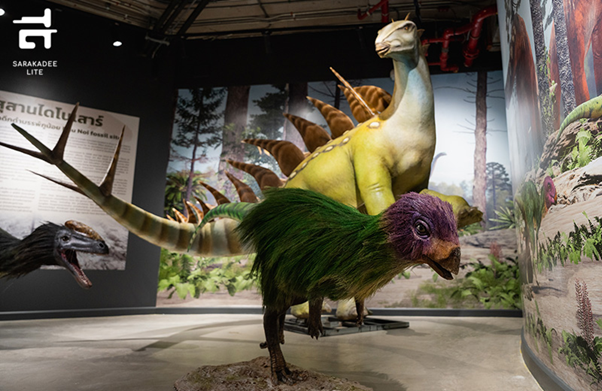
Dinosaurs from the THAINOSAUR exhibition (Image source | Sarakadee Lite)
My friend’s 5 year old daughter is an avid fan of dinosaurs, she can barely read but ask her to identify a dinosaur and she’ll tell you their long and complicated scientific names. Her backpack is always filled with dinosaur toys and coloured pencils ready to draw a Velociraptor or two. I’ve been on the lookout for dinosaur related activities and events for her, and luckily with the release of Jurassic World: Rebirth this year (which was filmed in Thailand), the country has had no shortages in dino-happenings during this craze. In the process I discovered “THAINOSAUR”, an exhibition in Bangkok that showcases prehistoric beasts found in Thailand – from fish, turtles, crocodiles to dinosaurs.
Everyone’s heard of T. Rex, but have you heard of Siamosaurus? The exhibition held at Museum Pier takes you on a journey back in time when dinosaurs like the Siamosaurus roamed what is now the Northeastern part of Thailand. Each level of the museum transports you to a different era, from the Triassic, Jurassic to the Cretaceous period. I had no idea that Thailand, a relatively small country, would hold so many species of dinosaurs beneath its earth!
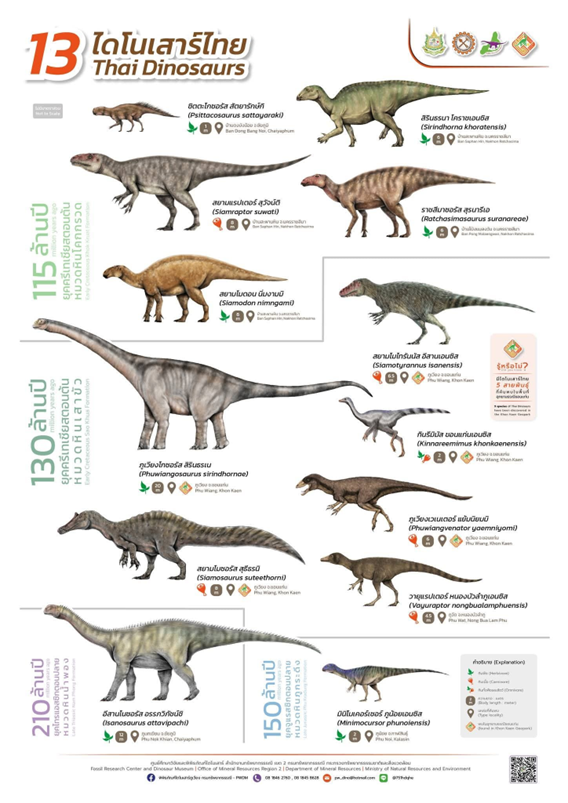
The 13 new species of dinosaur discovered in Thailand (Image source | Khon Kaen Geopark)
It all started in 1976 when the geological team was sent out to explore and find uranium deposits in the Phu Wiang mountains in Khon Kaen. To everyone’s surprise, a fossilised femur of a sauropod (long-necked dinosaur) was unearthed. This discovery garnered interest from palaeontologists around the world and started an on-going collaboration between Thai and French scientists. Over the years, many bones, teeth and footprints have been uncovered all over the Khorat Plateau or the Isan region. So far, 25 species of dinosaurs have been discovered in Thailand, of which 13 were new species to the world. Right now there is a new discovery in excavation site 3 in Phu Wiang which is pending identification, this might be the 14th Thainosaur discovery!
Apart from Khon Kaen where 3 carnivorous and 2 herbivorous species were found, discoveries have also been made in other provinces. From Nong Bua Lamphu, the Vayuraptor nongbualamphuensis, from Chaiyaphum, two herbivorous species including the Isanosaurus attavipachi, from Nakhon Ratchasima four different species including a raptor Siamraptor Suwati and from Kalasin a small dinosaur only at 1m, the Minimocursor phunoiensis. As you can see, many of these Thainosaurs are named after the area they were found in.
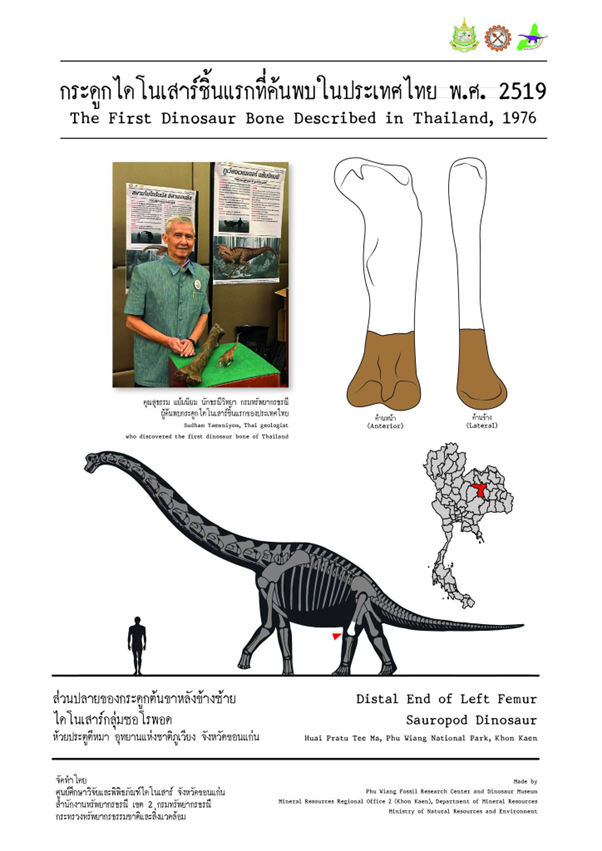
(Image source | Phu Wiang Dino Museum)
Today, museums have been set up near these excavation sites to educate, showcase, research and preserve the stories of these beasts that lived over a 100 million years ago. Phu Wiang National Park in Khon Kaen has nature trails that take you to dig sites, some still active, where dinosaur bones were found. Here, the Phu Wiang Dinosaur Museum also has the first bone discovered on display.
Only about 200km away in Kalasin, another museum shares this celebration of the prehistoric beasts. The Sirindhorn Museum has larger exhibitions on display and includes a viewing platform that overlooks one of the most complete dinosaur fossils found in Thailand. Not too far away in Phu Faek Forest Park you can also walk right up to a set of dinosaur prints, ones made by a 7-8m carnivorous carnosaur that lived about 140 million years ago. Over in Nakhon Phanom the Tha Uthen Dinosaur Footprints Park has a large amount of well preserved prints in solidified mud (202 to be exact) of mostly small Ornithomimosaur tracks and a few made by the Iguanodon.
At the beginning of 2024 scientists discovered more footprints that are thought to be 225 million years old. Knowing that new discoveries of the prehistoric past are still being made here in Thailand is exciting – who knows, look at the rocks in Isan enough and you might be the next person to uncover these million year old secrets.
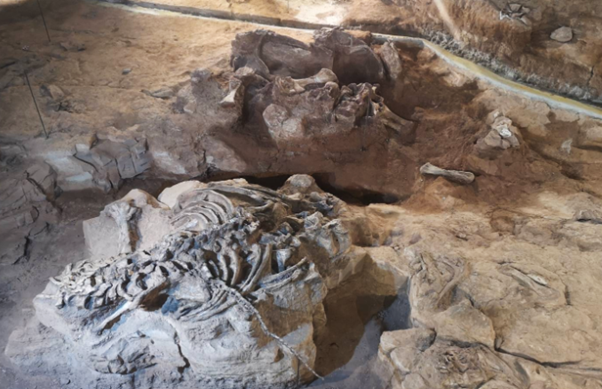
The fossil of a Phuwiangosaurus sirindhornae in a lying position at Sirindhorn Museum (Image source | Guns – The Fossil Forum)
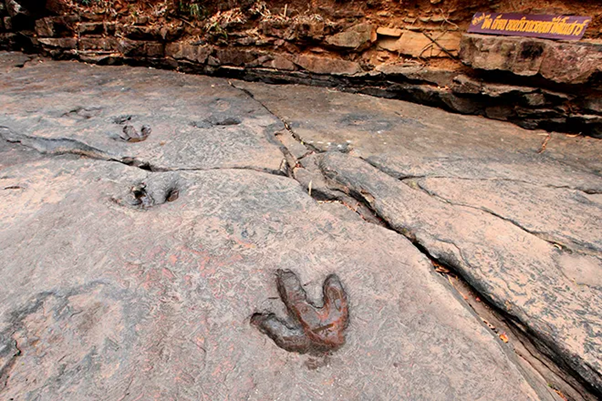
Dinosaur footprints at Phu Faek Forest Park (Image source | Thailand Discovery)
References
The 101 World | Khon Kaen Geopark | Phu Wiang Dinosaur Museum | Museum Pier | Edu Tour


