Whilst scrolling through Lion Brand blogs I noticed a common element amongst the tantalising images of food and desserts on the page, blue and white tableware that present them. From plates to bowls and trays with pedestals, these patterned ceramics (often lai supparot or pineapple pattern) have become the choice for many Thai restaurants and home cooks in and outside of Thailand. It reminded me that apart from earthenware and terracotta, there’s a whole other world of delicate and intricately made Thai ceramics that I had forgotten about – the world of porcelain like those blue and white wares and Benjarong.
Benjarong is a style of Thai porcelain dating back to the Ayutthaya period around the 18th century. The name describes the 5 primary colours traditionally used, benja means 5 and rong means colour. The colours were white, yellow, black, red and indigo, however modern Benjarong wares have evolved to include an expanded palette. Motifs from Thai art, culture, nature and literature are often featured, skillfully applied by experienced artists with a tiny brush in hand.
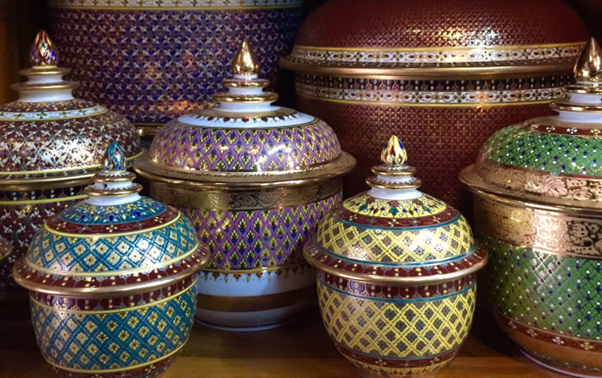
Benjarong wares (Image source | Noolek Benjarong)
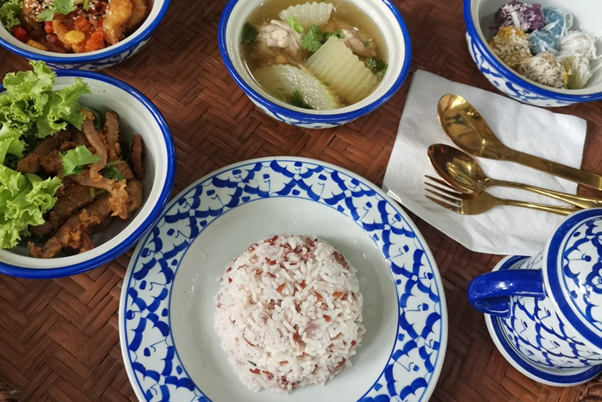
The blue pineapple pattern or ‘lai supparot’ often found on ceramics presenting Thai food (Image source | Sook Took Kum)
Although the production and techniques of Benjarong were rooted in China, over time it has shifted and changed into something uniquely Thai. During the time when trade was flourishing between the 2 countries, fine china was gaining popularity within the circles of Thai royalties and nobles. This popularity coupled with a cultural renaissance during that era saw a push for Thai art to appear on functional wares.
However, due to the lack of expertise, equipment and suitable clay, initially Benjarong ceramics were commissioned to be made in China. Thai artists would design the patterns and motifs but it would be painted on by Chinese artists. Unfortunately these works did not reflect the intricacies of Thai art well, the complex patterns required years and years of training and the artists were unfamiliar with the style. Later, blank ceramics were imported to Thailand and painted by local artists instead. Eventually people were also sent to China to learn how to produce the ceramics themselves in Thailand.
After the Ayutthaya period, the demand for Benjarong grew and ‘lai nam thong’ or golden patterns became an addition during the start of the Rattanakosin era (early 18th century). Enamel paint containing real gold (18k) embellished metallic accents to these Benjarong wares, increasing its elegance, sophistication and popularity amongst the elites. By the reign of King Rama II in the 19th century, Benjarong hit its peak and was very sought after.
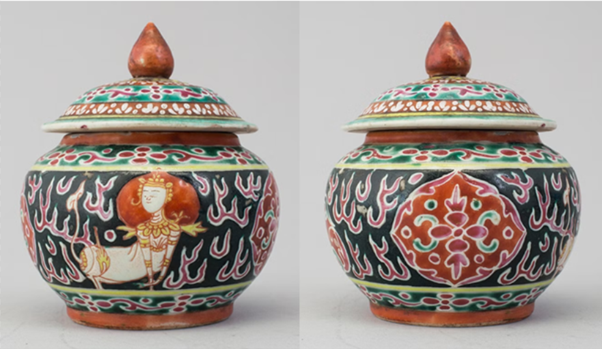
Benjarong from the Ayutthaya period (Image source | Bukowskis)
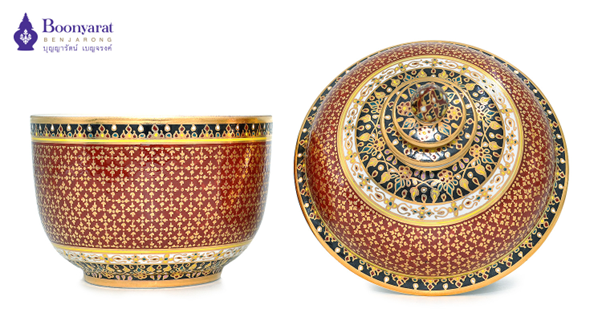
Benjarong with lai nam thong or golden patterns (Image source | Boonyarat Benjarong)
The making of Benjarong is a long and arduous process, requiring multiple firings and often multiple days to weeks to paint. It starts with Kaolin clay, a clay that is strong, has a soft white colour and doesn’t shrink much when fired at high temperatures. For consistency, moulds are commonly used to form the shapes of glasses, rice pots, bowls, pedestal trays, tea sets and so on. Once these vessels have been glazed and fired, they are passed onto artists for the enameling process. The first artist is responsible for painting on the outlines of the design, they are highly skilled and are often experts at particular patterns. Delicately and accurately, these artists paint on the designs with a fine tipped brush before passing the work onto colouring artists who fill in colours within the outlines. Once the enamel work is complete, they are fired again at around 800°C for 4-5 hours.
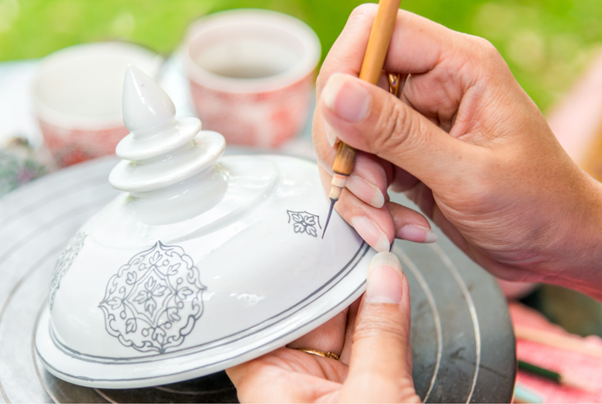
Patterns are hand drawn onto blank porcelain with a fine tipped brush (Image source | Baan Tip)
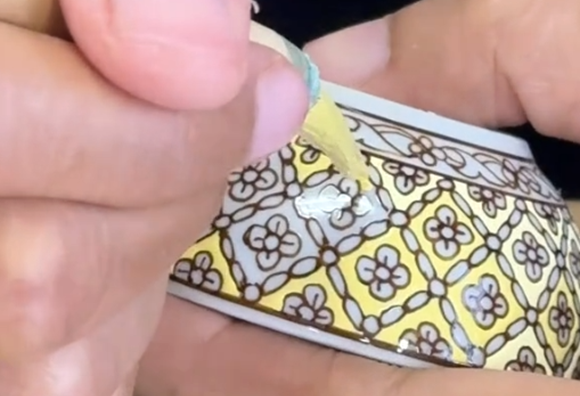
Artists paint in colours within the outlines (Image source | Buran Benjarong)
As time went on, the demand for Benjarong dwindled due to the increasing popularity of imported ceramics from places like Europe and Japan. The art struggled to stay alive and took a big hit in the 80s when a large Benjarong factory had to close down. Luckily in 2001, artisans affected by the closure banded together and formed a collective of artists to produce Benjarong products at Ban Don Ki Di Benjarong Village. Today, the traditional craft has been updated by adjusting form, functionality and design to survive in the modern world – existing as a collectors object, functional wares, gifts and souvenirs for people in and outside of Thailand.
Note : Ban Don Ki Di Benjarong Village is located in Samut Sakhon (location link) just outside of Bangkok. One can visit as a day trip for a local experience to learn more about Benjarong ceramics, buy straight from artisans and attend demonstrations and workshops. Tours and overnight stays are also available in the village.
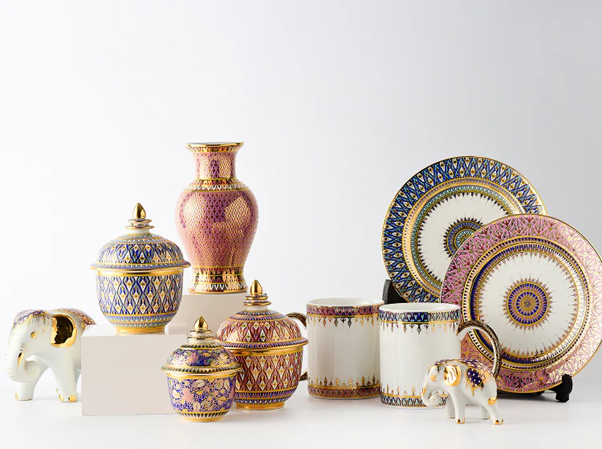
Modern Benjarong wares (Image source | Kanit Thai)
References
Benjarong | Thainess TV | National Geographic | Fan Club Thailand