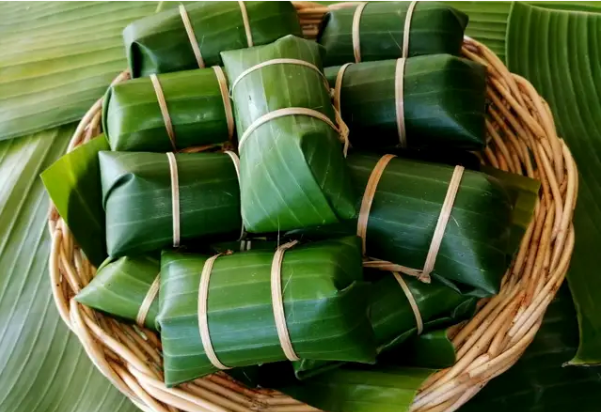
A few months ago I discovered a little teahouse tucked away at the back of the garden of a cafe. There were snacks and an extensive list of teas – matcha from different regions of Japan, many different grades of Oolong and even unique Thai flavoured ones. The staff came over to recommend their special blend, a tea inspired by traditional Thai desserts infused with tian op or candle smoke. The shop is called Loong Chong Cha which translates to ‘uncle brews tea’, and these were uncle’s unique creations. In this collection, each tea utilises a blend of different tea leaves, flowers, herbs and tian op. My friend and I picked a flavour and shared a pot, the taste was so unique and reminiscent of the Thai desserts I had growing up like khanom alua and luk chup. However, it made me wonder how food could be scented by candles, so what is tian op?
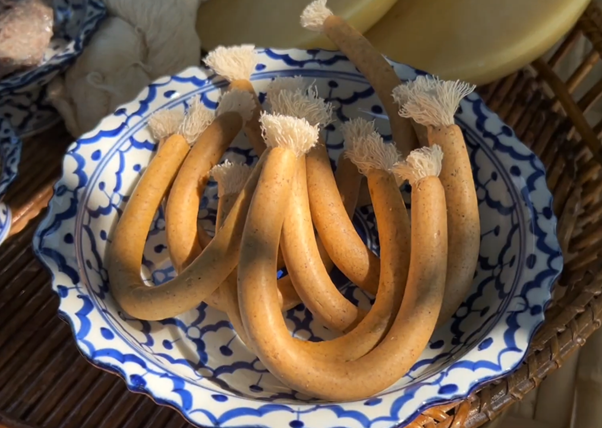
A plate of freshly made tian op (Image source | Thantong)
Tian op which translates to baked or scented candles is an old Thai culinary technique originating from the royal court. It infuses food with fragrance through the use of candle smoke. Unlike scented candles that are commonly used around the house, these are crafted from a variety of aromatic dried plant materials and oils. In the royal court, desserts are intricate and beautiful which feed the eyes and mouths. The candles dress these up further by adding another sensory experience, scent. They are often made into a U-shape with double wicks, which is more compact for placing into smoking containers and also allows for double the amount of smoke. Sometimes the smoke infusion happens to the ingredients that go into making a dessert such as coconut milk, water, flour or fillings. Other times they are used as a finishing touch to completed desserts or even during both stages.
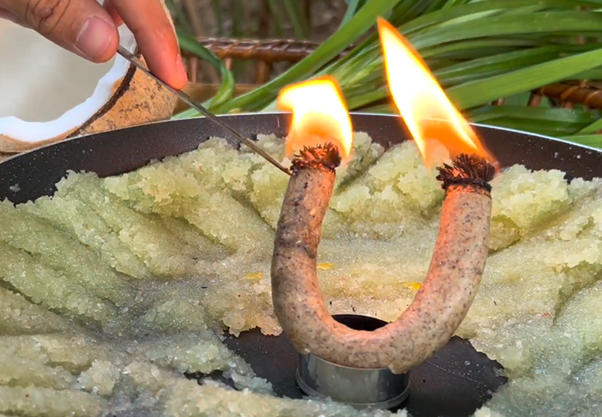
Lighting up a candle to infuse dessert fillings (Image source | Thantong)
Candle making may not seem to be too complicated, however making tian op is a labour of love and a multi-day task. Starting from the cotton wicks, these have to go through a process to ensure no pre-existing scent remains. First they are boiled in nam ob or Thai scented water, dried, then infused with tian op or an incense multiple times. The strands are then rubbed and completely coated with a fragrant essential oil of choice, such as jasmine, ylang-ylang or sandalwood.
The time and effort doesn’t stop there, the ingredients that go into tian op also need to be finely ground. In one of the recipes published by the Rajamangala University of Technology Phra Nakon, the recipe calls for 30 kaffir limes to be peeled, dried and ground, just for making 8 candles. Luckily in the modern day many varieties of herbs and spices can be bought in powder form (otherwise you’ll be getting a workout from the mortar and pestle!). Some of the ingredients that go into tian op are – kaffir lime peel for its strong citrusy and herbal punch, chalood an aromatic vine with a cooling scent, nutmeg for the sweet and nutty tones, a touch of camphor for its refreshing menthol notes, frankincense for its woody and earthy warmth, and brown sugar for its sweet aroma.
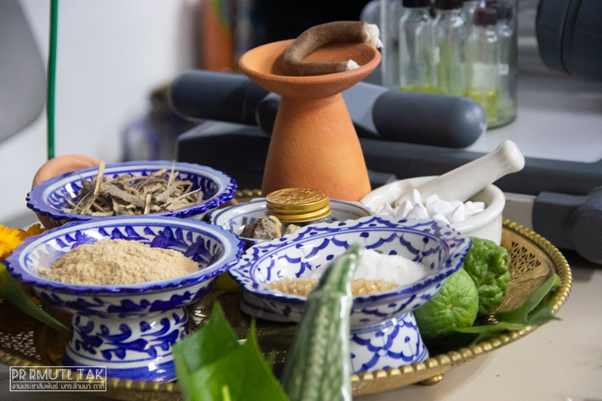
Some of the raw ingredients that go into making tian op (Image source | Rajamangala University of Technology Lanna)
The combination creates a complex and distinct fragrance that is sweet, earthy, floraly and woody. What goes in and how much is dependent on personal preference, for certain desserts the makers may want stronger floral notes where others may want a softer spiced aroma. Once all the dry ingredients are mixed and ready, chunks of beeswax are warmed up until pliable. The powder mixture is then slowly kneaded into the beeswax in small batches until well incorporated. This ‘dough’ is rolled into a long sausage-like shape and flattened ready for the wick to be placed on top. While twisting the wick tightly, the ‘dough’ wraps up and over to enclose it, leaving a bit of wick exposed at each end. Finally the candle is rolled again until smooth, shaped and the wick ends are cut into equal lengths. After this arduous process tian op is ready to be lit up and used in the culinary world, whether that’s desserts, rice, water or tea.
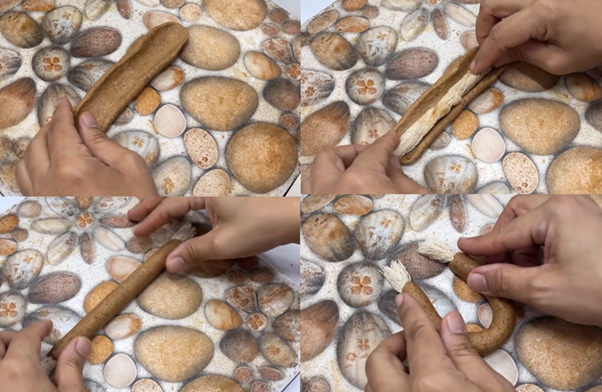
The final steps of making tian op (Image source | Suan Dusit University Suphanburi)
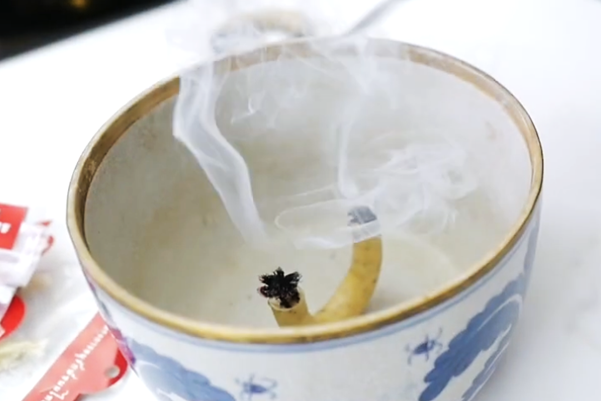
Once the wax starts to melt, the flame is extinguished and the lid is put on quickly to contain the smoke. Tian op are infused for at least 30 minutes, for a strong fragrance many will leave them overnight. (Image source | Thai Dessert Journal)
References
Atlas Obscura | Rajamangala University of Technology Phra Nakon | KRUA | Thantong