Just like regional foods that develop unique flavours from their surroundings, music also often reflects the environment and lifestyle of the people who create and play it. In Part 1 of this exploration into the traditional sounds of Thailand, we saw classical bands and instruments that were used in ceremonies, performances and the royal court. Instruments that are adorned with intricate gold details and bands that are mostly played sitting down. In Part 2 we’re picking up the tempo and tuning into the vibrant folk sounds from Isaan, the Northeastern part of Thailand where foods are bold, clothes are colourful and ‘muan’ (fun) is the anthem.
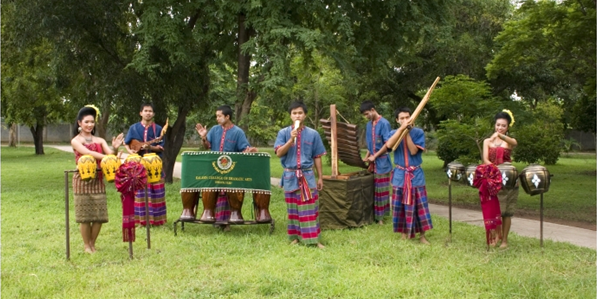
A typical Pong Lang band (Image source | CBT Thailand)
A region with roots shared with Laos, many of the instruments are also shared, influenced or adapted from there. They are inspired by daily life and made with locally found materials – from things used at the farm to things found in the kitchen. Many of the instruments were traditionally played individually by soloists that had their own flairs and styles, which made it hard to bring them together. However as time went on people figured out how to play harmoniously and Wong Pong Lang or the Pong Lang band became the iconic sound of Isaan that everyone knows and loves. Below are some of the instruments often seen in the band.
Phin
A lute-like deed or plucking instrument with 2-3 strings that usually sets the rhythm and melody in the band with its bright and cheery sound. Crafted from one solid piece of wood such as jackfruit wood, the body often resembles the shape of leaves, the neck long with frets and a decorative head carved to look like Naga (a mythical serpent). Nowadays electric phins have become popular and widely used.
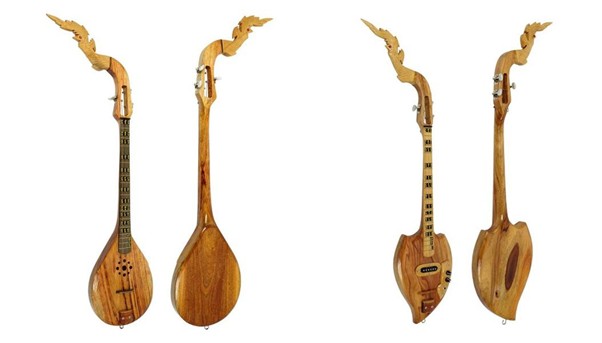
Phins with different body shapes, left acoustic and right electric (Image source | Rala Music)
Hai Song
Who would’ve thought that items found in the kitchen could become an instrument? Hai or jars of different sizes that are used to ferment fish, make sato (sticky rice wine) or to salt things are turned into a bass like instrument. Rubber bands, sometimes cut from the inner tube of tyres are strung across the opening of the jars, once plucked with the thumb and index finger the echo and vibration creates a deep sound. Nowadays the sound has been replaced by an actual bass in the band, however hai song has become a spectacle with dance choreographies that involve pretend playing of the instrument.
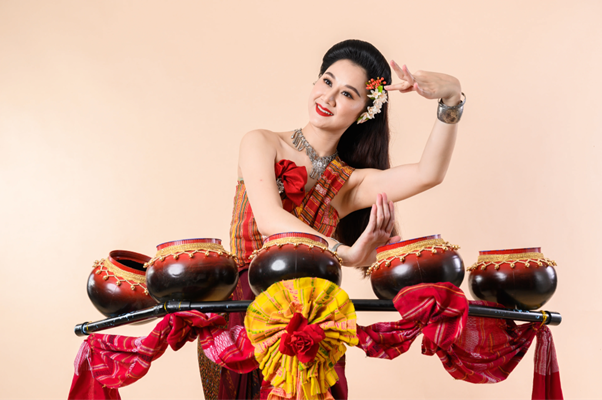
Nang hai or hai dancers often dance behind the instrument with choreography that matches the beat of the music (Image source | Teesudshow)
Khaen
One of the icons of Isaan music, khaen is an instrument that has a long history for the people in the Isaan and Laos region. It is a pao or blowing instrument that is usually made from 6-8 pairs of bamboo pipes. To make a sound, players blow or suck air into the wooden centre mouthpiece called dtao khaen which houses the pipes. No sound will be made if the holes on the pipes are not covered, there is one hole at the front for the player’s thumb and the rest of the holes are on the side. To prevent air from escaping, black insect wax is used to seal the area between the pipes and the centrepiece. A thin copper-silver alloy sheet is used as a reed inside of the centrepiece.
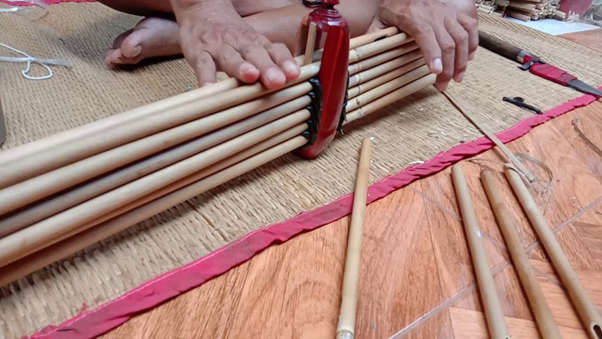
The making of khaen (Image source | Kor-Kai)
Wod
An instrument bred and born in the province of Roi Et by Ajarn Songsak Pratumsin that has now become the pride and joy of the area! In Isaan, after the rainy season farmers and children will swing a wod around to play and create loud noises to signal to the heavens that they have received enough rain (read more about rain and the rocket festival here). The creator wondered whether these noises could be adapted into notes that could be played harmoniously with other Isaan instruments and was eventually successful with his experiments.
A wod is made from a type of thin bamboo with 7 – 13 pipes depending on the size. These are varied in length and arranged in a circle around a core piece. The top part is cut at an angle and the bottom plugged with wax to create the desired note. The ‘nose’ which looks like a dark coloured mound is where the player rests their bottom lip and is made from the wax of a local insect called kee sot. It is played by holding and twisting the instrument with one hand while the player blows into each section of the bamboo.
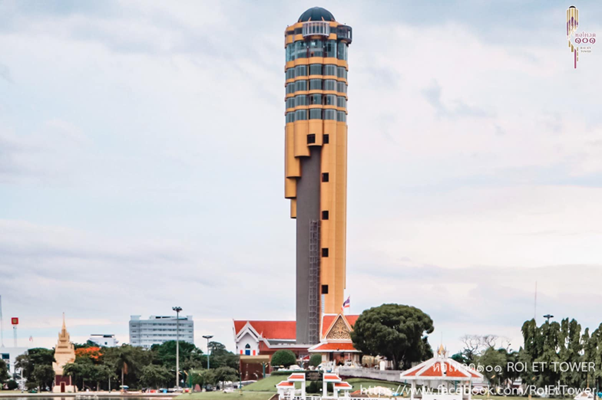
The Roi Et Tower in the shape of a wod (Image source | Roi Et Tower)
Pong Lang
A dtee or hitting instrument that was also adapted from the daily lives of people. In Kalasin (province), a few pieces of Areca wood were tied with vines called kroh lor and used in the fields to make loud noises to scare away birds and animals. In the village, something similar was used instead of a bell to signal time, help people find their way home, or to call for help. Later this was adapted into an instrument and hardwood such as monkey fruit wood was used to produce a louder and clearer sound. Pieces increased to 9, 12 and 13 and were strung up at a 45 degree angle. Pong long is played like a xylophone by hitting each piece with a solid wooden mallet.
It was said that a lot of the pong lang melodies were created by livestock farmers who after a long day of travel, played music to enjoy themselves and shook cows and buffalo bells (which were wooden at the time) to create music.
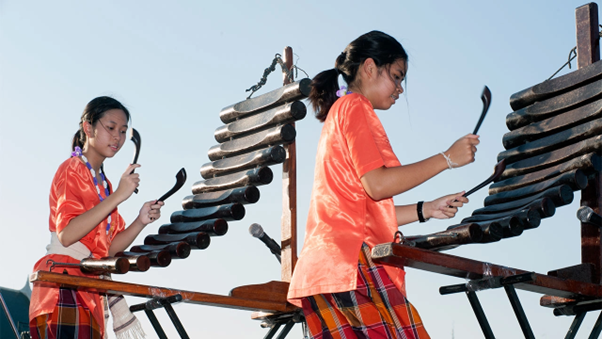
Pong lang instruments(Image source | Thairath)
Lastly please enjoy this video of the sound of Isaan with the instruments and their legendary masters.
Article By Oun V.
References
Rajabhat Mahasarakham University | Bunditpatanasilpa Institute of Fine Arts | Isan Club Chula University | AWAKE MEDIA | Sirindhorn Isan Information Center