

Thai Curry Puff Recipe | Karipap | กะหรี่ปั๊บ
Another dish that is believed to have been adapted from Portuguese traders long ago this delicious and popular crispy treat…


Thai food generally has a pretty simple naming convention – pad krapao is a stir fry that has krapoa (holy basil) as its main flavour and khao niew mamuang literally translates to ‘sticky rice mango’. Pretty self explanatory! However there are also food and desserts that have puzzling names, ones that even locals scratch their heads at. An example is kanom baa bin, the name translates to ‘crazy or maniac snack’. If you were to judge a dessert by its name, one would think kanom baa bin must be something with surprising flavour combinations, strange ingredients or something that is a little bit out there. But this dessert is none of that, it is made with the most common ingredients, sweet and coconutty with slightly crispy outsides and a soft and chewy texture inside. It’s no wonder so many people have questioned the origins of this name, what it is and what the name means are a complete mismatch!
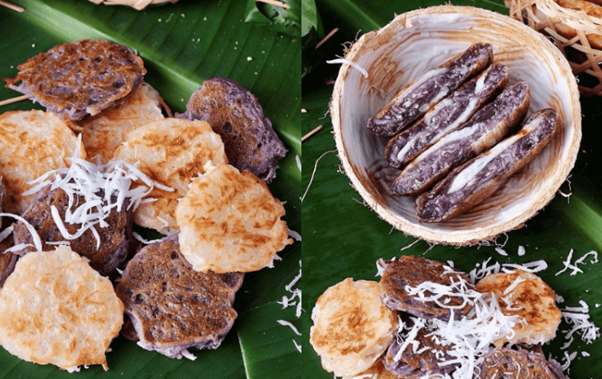
Kanom baa bin (Image source | Baan Pim Woon)
There seems to be 2 main theories on how the name baa bin came to be. One originated in Ayutthaya, a province not too far north of Bangkok and the other all the way from the city of Coimbra in Portugal. If you’re familiar with the history of Thai desserts, it would be no surprise to you that kanom baa bin could be another one of the many Thai desserts with Portuguese influence.
It was said that Roman Catholics who came over to spread religion and settled in Thailand during the Rattanakosin Period brought over a dessert from the convent called queijadas de Coimbra. This dessert, once baked, has a crunchy crust made from wheat flour and butter, and a soft and bouncy filling made from a mixture of fresh cheese, sugar and egg yolk. Although delicious, these ingredients were not easily found in Thailand at that time. So begins the game of substitution. For the filling, shredded coconut, coconut cream and glutinous rice flour were used instead of fresh cheese, these created a similar texture and creaminess. The wheat flour and butter crust was omitted and this became the first version of the Thai adaptation of this dessert. Now, you might wonder how Queijadas de Coimbra turned into ‘baa bin’, they don’t sound too much alike. In spoken Thai, the name is quite long and complicated to pronounce, so most of it was cut off leaving ‘coimbra’. With enough mispronunciation, perhaps the name went through an evolutionary process that looks a little like, ‘imbra, bra-im, baa bin’.
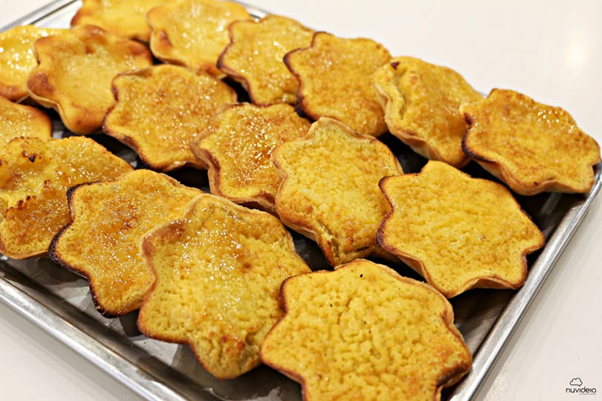
Queijadas de Coimbra, a convent dessert from Coimbra in Portugal (Image source | Pastelaria Penta)
The other theory told by an interview with Mae Supha (who has won recognition for her kanom baa bin) puts the origin of this dessert in the boating industry of Ayutthaya. According to her, the recipe was passed down by the Aerbkamol family who were owners of a boatyard in the Wung Daeng community. With wooden boats and structures came shipworms that bore holes into wood. They would burn lots of coconut shells to kill these and turn the coconut meat inside into desserts. This coconut meat combined with commonly found ingredients on a boat became kanom baa bin – a simple mixture with only a few simple ingredients, so why is the name crazy?
Shredding coconut meat was no easy feat with the tool available back in those days, and the flour had to also be pounded and milled by hand from sticky rice. With the amount required to make dessert, one would have to exert themselves, you end up shredding and pounding like a maniac, or someone who is ‘baa bin’. This theory seems plausible however interviews with others point the origins of this name to Aunty Bin or Pa Bin who was supposedly the first to sell this dessert at Tha Rua station in Ayutthaya. Kanom Pa Bin, or Aunty Bin’s snack then became kanom baa bin as people mispronounce it.
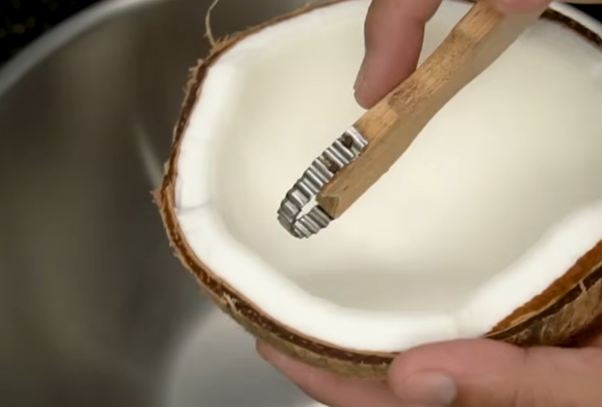
The tool for shredding coconut meat by hand (Image source | Gin Dai Aroi Duay)
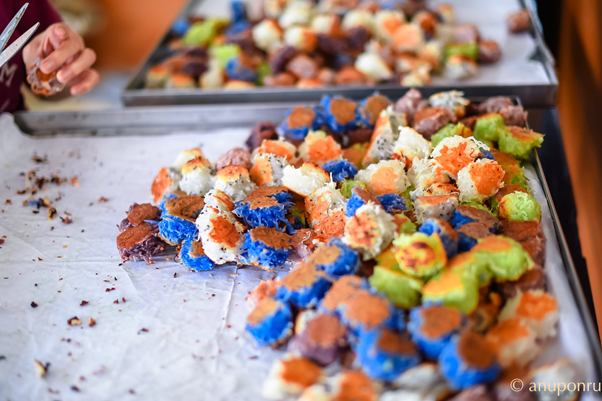
Mae Supha’s kanom baa bin, a more traditional style (Image source | Anuponru)
Unlike the mystery surrounding the name of this dessert, the recipe is quite simple. Using shredded coconut meat (choose older coconuts for firmer texture or younger ones for softer and sweeter taste), add around ½ the weight of the coconut meat in glutinous rice flour, a bit of salt and ¼ of the weight in sugar and water. Mix well until combined and cook on a medium heat pan until both sides are crispy and browned. Black glutinous rice flour is also often used to give it a dark purply hue. The more traditional style uses just enough glutinous rice flour to hold the shreds of coconut together, modern market stalls use a lot more which creates a chewier texture. Some recipes also use coconut cream in combination with water.
Whichever theory you lean towards, it’s undeniable how delicious this dessert is. Biting through the crunchy exterior into a chewy and coconutty centre is an experience I believe everyone should have at least once!
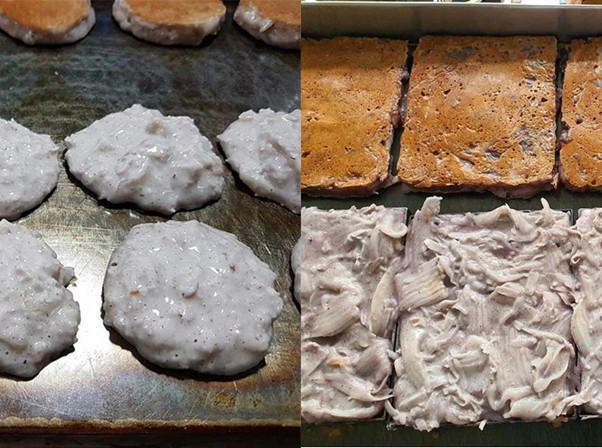
The version of kanom baa bin you will often see in Bangkok at markets and street stalls (Image source | Kapook)


