
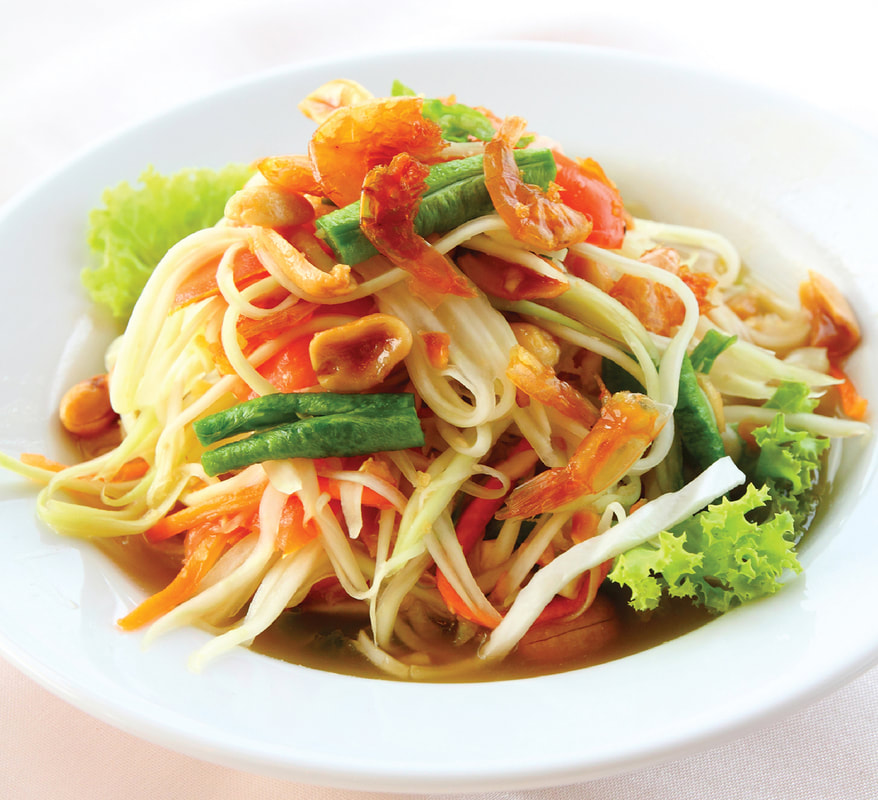
What do you know about Somtum, Thai green papaya salad?
samuiholiday.com Som (Thai: ส้ม) which’s north-eastern Thai word means sour taste and Tum (Thai: ตำ) means pounding with pestle to…


Long weekends often see us travelling outside of Bangkok, exploring the different flavours Thailand has to offer – each province and region with their own landscape, food, products and way of life. On one such trip, the decorations at a local morning market caught my eye. Hanging from the roofs of the little bamboo huts lined with local food and handicrafts were vibrantly coloured diamond and spider web shaped mobiles. I walked through and under them, looking up to admire the beautiful display as they swayed with the wind. Asking what they were, the lady replied, “webs to fight the bad spirits, to protect”. Not just a decorative item? This made me wonder what the whole story was as I bought a mini version as a souvenir to hang up on my wall.
I found out that those were a type of ‘flag’, a subcategory of what’s called thung (ธุง) in Northeastern Thailand, Isan. To understand thung one must understand the beliefs of the Isan people. With a mix of Buddhism and Tai folk religion, deities, spirits and ancestors play an important role in the wellbeing of one’s life. Some believe that to offer thung to a temple is considered a great act of merit making, merit that will help bring peace and help them be well in this life and the next. Merit that can also be shared with their loved ones that have already passed.
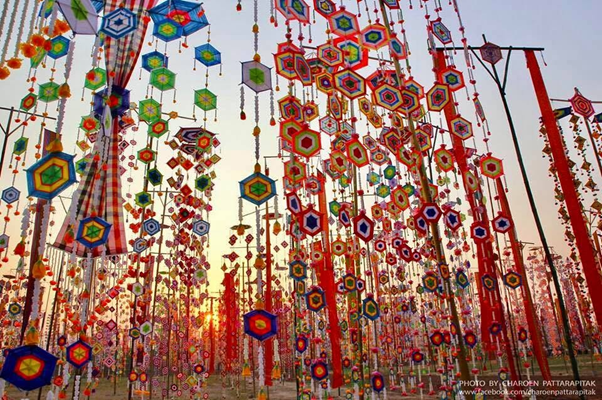
Sea of thung from a festival in Kalasin (Image source | Chareon Pattarapitak)
Others also believe in the folklore, that there was a time when demons and evil spirits went up to the heavens and caused fear amongst the angels and deities. The guardian then created a flag as a symbol of strength, reminding the deities to be brave every time they see it. With the demons successfully driven away, people started to use thung during ceremonies as a shield, a way to fend off demons and as a symbol of victory against evil. Some believe that they are a bridge that connects to the divine beings and that when they die, their spirits can hold onto the tail of the flag and follow it up to heaven.
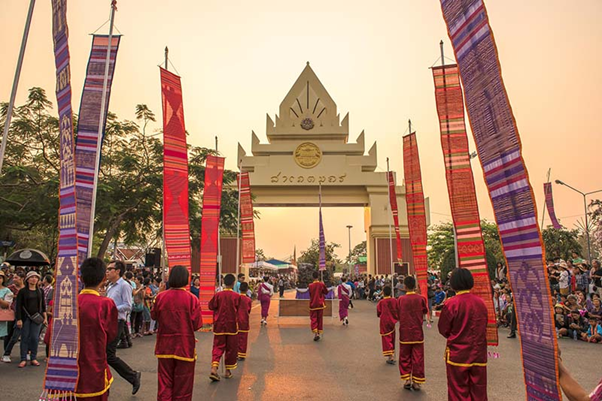
A parade of thung chai (Image source | Miracle Tour Thailand)

A wide variety of things (Image source | ศรัทธา ลาภวัฒนเจริญ, 2567)
No matter what the belief, thung is an integral part of the ceremonies in Isan – from the biggest event of the year like boon phawade to New Years, ordinations and robe offerings. You may see a few different types of thung at these events but the most common is thung chai (chai means victory) or also called thung phawade (as they are often used in this ceremony). These are long strips of woven dyed silk, around 20-40cm wide and 1-6m in length. They are hung vertically and can feature traditional patterns, images from Buddhism, folklore or animals and plants. The 3 sections of this type of thung are the head, flag and tail. The head, usually a wooden frame that connects to a pole – they are either stationed in specific directions or held up by people in a parade. The flag, either fully woven with fibres or with bamboo sticks inserted in sections to add structural integrity, preventing the flag from tangling on itself in the wind. The flags are intricately crafted by women in the community, each with their own styles, colours and motifs, expressing their creativity through each woven thread. The tail, often strings that hang in a straight line or in a triangular shape with beads and other materials to weigh the flag down.

Thung from Ubon Ratchathani with Buddhist motifs (Image source | Baan Bua Charoen)
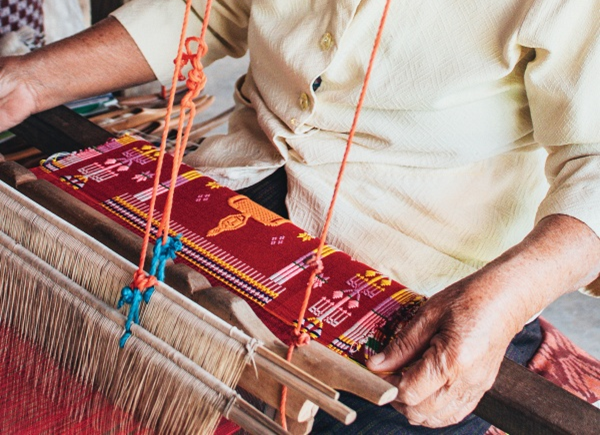
Weaving a thung (Image source | Sarakadee)

Weaving a thung (Image source | Sarakadee)
The other type of thung is thung yai or thung yai maengmum, yai means web and maengmum means spider. They are the ones I saw at the market. Traditionally they are also made from dyed silk wrapped around bamboo sticks, however most modern ones are made from commercially available yarn and wooden sticks. Thung yai can be made with 2 or 3 sticks that cross each other in the centre, 2 sticks create the diamond or square design and 3 sticks create a hexagonal spiderweb shape. Creating these beautiful displays is an activity that gathers people from the community together, as they weave and wind each string, conversations flow. Multiple pieces can be strung together to create impressive displays, from long mobiles to chandeliers.
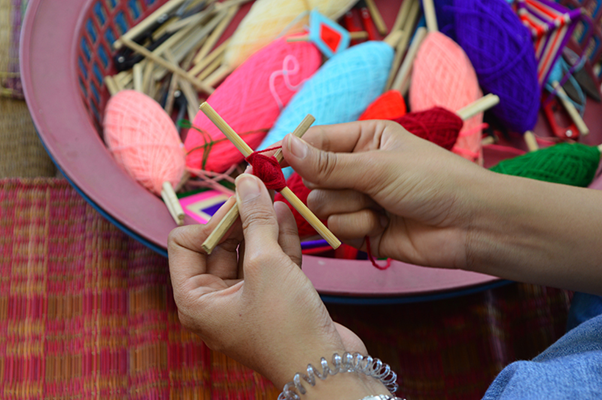
The making of thung yai at Sila Homestay (Image source | nairobroo)
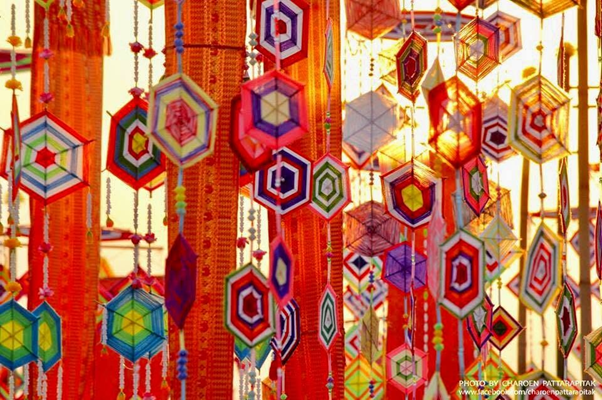
Sea of thung from a festival in Kalasin (Image source | Chareon Pattarapitak)
Making and using thung in ceremonies is a tradition that has been passed down for Isan people since the olden days. Today, both types of thung are not only used in ceremonies but have been adapted into different forms with a wider range of designs and materials used. Turning them into decorative items, souvenirs and other products have also generated extra income for the communities that create them. I was so mesmerised by the display at the market and I hope the newer generations will keep the tradition alive!
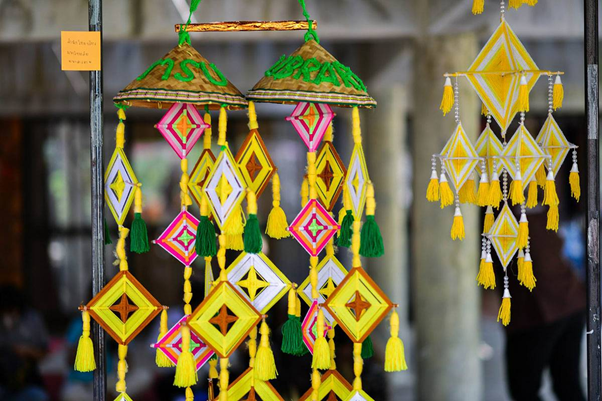
Thung yai chandeliers (Image source | CampusStar)
References
Esanpedia | KKU Art & Culture Center | Ministry of Foreign Affairs


